
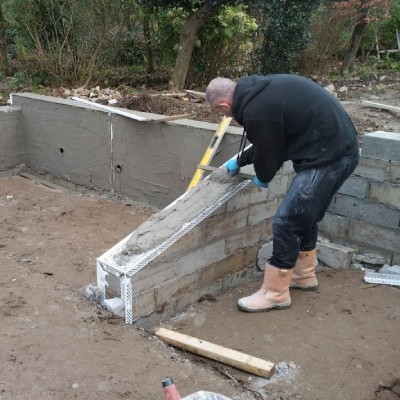
Rendering whether with sand and cement or sand or lime is a skill which can only be aquired through practice. However there are set ground rules to get good results.
Cement renders are normally composed of 2 coats, a scratch coat (base coat) followed by a top coat. To achieve clean lines on corners and edges then metal or plastic beading is used fixed to masonry. The base coat is added with waterproofer and plasticizer in the water and is generally 4:1 sand/cement. The top coat needs to be a slightly weaker mix so as not to pull off the scratch coat when curing. I use 5:1:0.5 sand/cement and hydrated lime. The hydrated lime acts as a plasticizer. Do not confuse hydrated lime with natural or hydraulic lime.
When using lime renders on period properties or where the substrate is likely to move often a three pass coat system is used. The stone will often have a harling coat thrown on for key with a ‘dubbing out’ coat to fill big voids, followed by a second pass and then a thinner topcoat. Different grade NHL (Natural Hydraulic Lime) are used generally NHL 2, 3.5 or 5 depending on the substrate and exposure. Lime putty is often used fir interiors for friable backgrounds.
Leave a Reply